



The Flame of Love statue is the single most ordered piece in our shop. It outsells everything else we make, and it is bought almost entirely by people who already know what it is. This article is for everyone else — the ones who saw it on a friend's shelf, or at a prayer group, and wanted to know what they were looking at.
A Hungarian widow with six children
Elizabeth Kindelmann was born in Budapest in 1913, the thirteenth child of a family that lost almost everything. She was orphaned young, worked as a labourer, married, and was widowed in 1946 with six children to raise alone under a Communist government that had little use for her. She took factory work. She was, by every ordinary measure, nobody.
From 1961 until 1983 she filled notebooks with what she said she received in prayer. Those notebooks became The Spiritual Diary. She died in 1985.
What the devotion actually is
The Flame of Love is not a new Marian title and not a new apparition site. It is described in the diary as a grace — an outpouring from the Immaculate Heart, given for this particular moment, and given on one condition: that it be passed on.
That last part is the whole shape of it. The Flame is not something you acquire and keep. It is described as spreading from heart to heart, and the devotion's practices all point outward — prayer for others, particularly for priests, for the dying, and for those who have no one praying for them. The most characteristic practice is simply to add a short petition to the Hail Mary, asking that the Flame of Love spread over all humanity.
Where the Church stands
This matters, and we would rather you heard it from us.
The Spiritual Diary carries an imprimatur granted in 2009 by Cardinal Péter Erdő, Archbishop of Esztergom-Budapest and Primate of Hungary. An imprimatur is a real thing — it means a bishop has judged the text free of doctrinal error and permits its publication. It is not the same as the Church declaring that the events described happened.
Private revelation, however well attested, is never binding on Catholic faith. No one is required to believe it, and nothing in it adds to what the Church already teaches. It is also worth saying plainly that promises attached to a devotion are not mechanical. Nothing works by being owned. A statue on a shelf does nothing at all; a statue that gets a family praying does a great deal, and it is the praying that is the point.
We sell a lot of these. We would rather sell them to people who understand that.
Why the statue looks the way it does
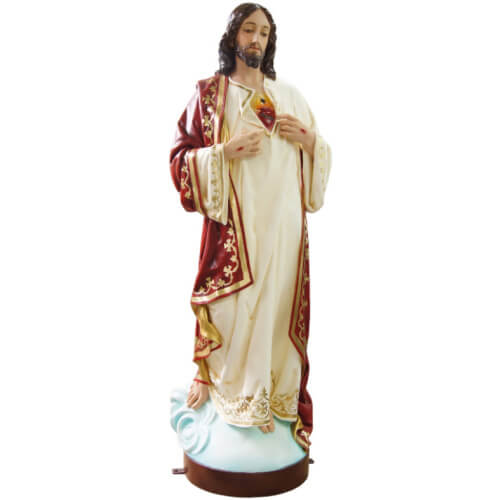
The figure shows the Immaculate Heart with the Flame itself — not the crown of thorns of the Fatima image, and not the sword of the Sorrows. The Flame is the subject. Everything else in the composition is subordinated to it, which is why the statue reads clearly from across a room even at the small size.
Choosing a size
12 inches is the one people buy. It is the size for a home altar, a bedside, a prayer corner, or the table where a family says the Rosary — which is precisely where the devotion asks it to be. If you are buying your first one, buy this.
19 inches is for a room rather than a shelf: prayer cenacles, Flame of Love groups, parish devotional corners, and homes where the statue anchors the space. Available in several finishes.
39 inches is sanctuary scale, for parishes and chapels where the devotion is established.
The 12" and 19" are in stock and ship within 48 hours.
Flame of Love 12" · Flame of Love 19"
If you are starting the devotion
Start with the diary, not the statue. Read it first, decide what you make of it, and buy the statue if the devotion takes hold in your household. That is the honest order of operations, and it is the one we would want for our own families.


