



Who is like God?
Michael's name is a question. In Hebrew, Mi-ka-el asks "Who is like God?" and the tradition hears it as his battle cry, the answer he hurled at the angel who wanted to be. He is one of only three angels named in Scripture, and the only one Scripture calls an archangel. He appears in the Book of Daniel as "one of the chief princes" and as "the great prince who stands guard over your people." The Letter of Jude shows him disputing with the devil over the body of Moses and refusing to condemn him in his own name, saying only, "The Lord rebuke you." And Revelation 12 gives the scene every statue of him depicts: "War broke out in heaven; Michael and his angels battled against the dragon." The dragon lost, and was thrown down.
From those few verses the Church built a full devotion. Michael is the captain of the heavenly host, the guardian of the people of God, the angel who stands by the dying and, in the older iconography, weighs souls at the judgment. By tradition he appeared on Monte Gargano in the fifth century, above Rome sheathing his sword at the end of a plague, and on the rock that became Mont-Saint-Michel. He is the saint people turn to when the trouble is not sickness or money but something that feels like an enemy.
The prayer of Leo XIII
In 1886 Pope Leo XIII composed a short prayer to St. Michael and ordered it said, kneeling, after every Low Mass in the world. The story that he wrote it after a vision of the coming century's evils is often repeated; what is certain is the prayer itself, which stayed at the end of Mass until 1964 and never left the people. St. John Paul II asked in 1994 that it be taken up again, and in many parishes today it is said after the final blessing.
"St. Michael the Archangel, defend us in battle. Be our protection against the wickedness and snares of the devil. May God rebuke him, we humbly pray; and do thou, O Prince of the heavenly host, by the power of God, cast into hell Satan and all the evil spirits who prowl about the world seeking the ruin of souls. Amen."
That is the prayer a family says at the door before leaving the house, and the prayer a parish says beneath his statue. If you are placing a statue, place it where that prayer will be said.
September 29
The feast of St. Michael, Michaelmas, is September 29, kept since the fifth century on the anniversary of a basilica dedicated to him outside Rome. Since 1969 the day honors all three archangels, Michael, Gabriel, and Raphael, together. Parishes named for him keep it as their patronal feast, often with a procession and a blessing of the statue, and it has become the usual day for a parish or a diocese to bless the police officers, firefighters, and paramedics of the town.
Police, soldiers, and those who stand guard
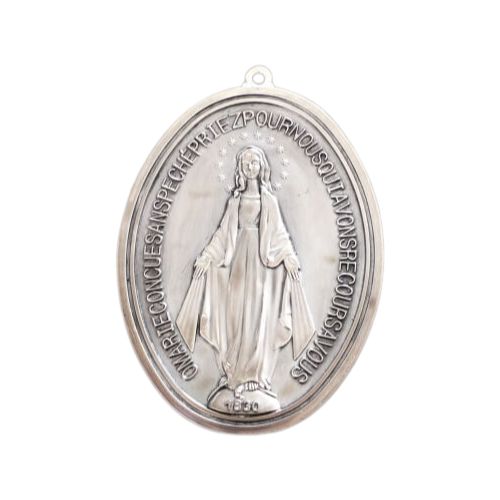
Michael is the traditional patron of police officers, soldiers, paramedics, and mariners, and of anyone whose work is to stand between others and harm. The St. Michael medal is the one most often found in a patrol officer's pocket or on a soldier's chain, given at graduation from the academy or before a deployment. Many dioceses offer a Blue Mass for law enforcement and first responders each autumn, and the statue of St. Michael in the church that hosts it is decorated for the day. Precinct houses, fire stations, and military chapels keep his image, and families of officers keep him in the front hall. The devotion is not sentimental. It is a prayer for protection by people who know what they are asking to be protected from, and the statue is the form the prayer takes when the person is out on shift.
Reading the statue
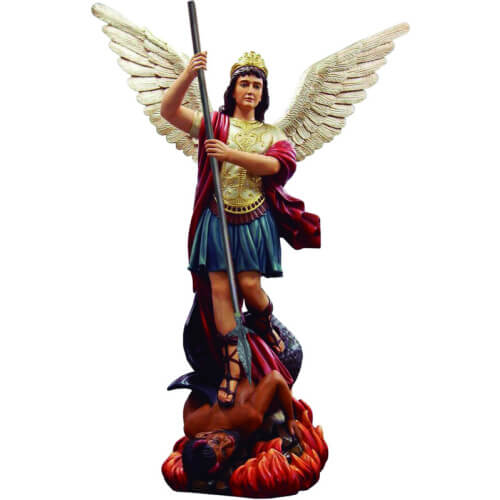
St. Michael is nearly always shown as a young man in Roman armor with wings, and the details are a vocabulary.
- The sword or spear. Raised, the fight is not over; pointed down at the enemy, it is won. Both are correct and each says something different about the moment depicted.
- The dragon or the devil. A statue "with dragon" shows Revelation's serpent or winged beast under his feet. A statue "with devil" shows a horned, human-shaped figure pinned beneath him, a form that grew common in the Baroque period. Neither is more correct; the dragon is more scriptural, the devil more literal.
- The shield. Often inscribed with his name in Latin, Quis ut Deus, the question that is also the answer.
- The scales. On some statues he holds a balance, from his role at the judgment of souls. This is the form favored for cemetery chapels and funeral homes.
- Wings up or down. Wings spread wide need width; wings folded need less, which matters when the statue is going into a niche.
Where to place him
At the entrance
Michael is a doorkeeper, and the entrance is his natural place. In a church that means the narthex or just inside the main door, facing the door, so that he is the last thing seen on the way out into the world. In a home it means the front hall, a shelf or a console facing the door, or the wall beside the door for a medallion. A 14- to 18-inch statue is the hall size; a 24-inch statue with dragon on a console table has the presence to be noticed by every visitor. Place him so the sword arm is toward the door.
In the garden
Outdoors, Michael faces outward, toward the street or the property line, standing guard over the house rather than looking at it. A statue on a low pedestal beside the front walk or at the gate suits most homes; the 56-inch statue with dragon on a pedestal at the corner of the property is the size for a rectory, a school, or a large lot. Order the Standard or Monotone finish, sealed for exterior placement, and anchor the base, because a winged figure with a raised sword catches wind. The Fancy finish, with the gold on the armor and the wings, is an indoor finish.
In the sanctuary or a side chapel
Some churches place Michael near the sanctuary, at the side, as the guard of the tabernacle; others give him a side chapel that becomes the parish's place for the prayer against evil and for the sick. A 56- to 76-inch statue is the size for either, on a base or a bracket that brings his head above the congregation's eye level.
Precincts, stations, and cemeteries
A lobby statue for a precinct or a fire station is 24 to 32 inches on a plinth, seen from the desk and touched on the way out. A cemetery entrance takes a 56-inch or larger statue in a Standard exterior finish, facing the gate.
Choosing one
The 14-inch St. Michael the Archangel is the front hall and desk size, and the one most often given to a new officer or a son leaving for basic training. The 24-inch St. Michael with dragon is the console-table and station-lobby size. The 56-inch St. Michael with dragon stands at a church entrance, in a side chapel, or on a pedestal in a garden in the Standard exterior finish. The 76-inch St. Michael is the life-size figure for a large sanctuary, a plaza, or the entrance of a cemetery. Each is a different sculpture from its own mold, not one statue offered in several sizes, and the finishes differ from statue to statue: each product page shows exactly the finishes that statue comes in.


